Combining a variation of projects, research and discoveries I've made over language in the past few years, I'm preparing to compile them into a new research project whose progress will be made public on this site. It contains the entire aim of the present blog, which is, to recapture the primordial essence of the original human (or super-human, divine) language as an expression of thought forms, manifested into physical sounds (vibrations) according to the idiosyncratic laws of expression.
This post is to signify that this blogspot isn't dead, and that very soon I'll be posting more entries.
Showing posts with label statements by the research society. Show all posts
Showing posts with label statements by the research society. Show all posts
Thursday, February 14, 2013

Thursday, October 6, 2011
Guide to Primordial Sounds
Quick Primer:
b - soft version of P, growth (like a crystal), emanation, beating, pulsation, period of a cycle; baros - to bear, belos - light/emanation of light
d - soft version of T, the depths, the netherworld, transcendence, subsurface, fluctuation, degeneration into or out of matter; d+r= duros/door - door, gate
g - reflection and projection within the abstract realm, actor, initiation, to go, beget; galos - charged fluid
k/c - reflection, projection, ricochet;
l - gliding, conduit, light (as opposed to heavy); lachos - light
m - the absorptive, the well, the Mother (mater - mother), the infinite ocean (maros - sea), mass generation, the endless absorbing element, darkness, space, buffer; aum - beginning and end
n - material absorption, repository, transfer of power, electric current; namos - designation/name
p - the physical, the mundane, the inanimate, the tool, the vessel, hardness; petros - rock
r - continuance, current, facilitation, transcendence; ratos - wheel, root
s - the existential sound: constant vibration, standing, traversing; os/is - to be
t - the material, hardness, hard version of D, the earthly, physical structure; telos/terra - earth
b - soft version of P, growth (like a crystal), emanation, beating, pulsation, period of a cycle; baros - to bear, belos - light/emanation of light
d - soft version of T, the depths, the netherworld, transcendence, subsurface, fluctuation, degeneration into or out of matter; d+r= duros/door - door, gate
g - reflection and projection within the abstract realm, actor, initiation, to go, beget; galos - charged fluid
k/c - reflection, projection, ricochet;
l - gliding, conduit, light (as opposed to heavy); lachos - light
m - the absorptive, the well, the Mother (mater - mother), the infinite ocean (maros - sea), mass generation, the endless absorbing element, darkness, space, buffer; aum - beginning and end
n - material absorption, repository, transfer of power, electric current; namos - designation/name
p - the physical, the mundane, the inanimate, the tool, the vessel, hardness; petros - rock
r - continuance, current, facilitation, transcendence; ratos - wheel, root
s - the existential sound: constant vibration, standing, traversing; os/is - to be
t - the material, hardness, hard version of D, the earthly, physical structure; telos/terra - earth
Wednesday, October 5, 2011
Verbs
It is apparent that Indo-Aryan verbs were based in stems consisting of a single syllable, that is a combination of a simple consonant with a coupling vowel that could couple the verb stem with a conjugational ending.
One example is the verb root ska-, meaning "to cut", which carries with it the full implications of "to cut or mold, to shape, create, form or scoop", such as can be read here.
The ending -t and -p are merely noun-making suffixes, which lend a particular material or definite quality to the initial stem; -t is indicative of something somehow having been enacted by ska-, such as skatos (shadow, shaped), while -p is used for more definite material objects like skapos (shape, vessel). Yet they are both very similar, as we see here.
It should therefore be known that the nouns of the Indo-European language originated from a proto-linguistic expression of active forms of existence, that is, verb-like constructions indicating a certain way of being and a certain nature of existence as emanated by the described thing. The study of such exact sound meanings will be gone over later. Thus, nouns did come from verbs, since verbs were initially stems from which suffixes could be attached to give more definitive forms; these roots were composed of sounds indicating a certain nature (a mode of existence), and therefore a certain active behavior consequent of it's existence. The world was defined by the way in which objects affected each other; based on understanding relationships between things. That was how something was defined; by how it reacted to other things. In the same way these things were described by initially verb-type words.
The roots are all directly descended from the emanations of these particular sounds, such as the sk sound formed as the root ska-, or st being sta- (to stand), and so on.
An example of conjugation:
sta-, to stand, present tense
1st Person staimi
2nd Person staisi
3rd Person staiti
Conversely, there is a variety of forms we can reconstruct for representing these old verbs. One discrepancy is that the vowel coupled to these sounds is relative. It is most certainly a more open vowel, but it ranges between an a, an o and an e in representation. Final decisions in representing these will be done from a careful aesthetic study.
One example is the verb root ska-, meaning "to cut", which carries with it the full implications of "to cut or mold, to shape, create, form or scoop", such as can be read here.
The ending -t and -p are merely noun-making suffixes, which lend a particular material or definite quality to the initial stem; -t is indicative of something somehow having been enacted by ska-, such as skatos (shadow, shaped), while -p is used for more definite material objects like skapos (shape, vessel). Yet they are both very similar, as we see here.
It should therefore be known that the nouns of the Indo-European language originated from a proto-linguistic expression of active forms of existence, that is, verb-like constructions indicating a certain way of being and a certain nature of existence as emanated by the described thing. The study of such exact sound meanings will be gone over later. Thus, nouns did come from verbs, since verbs were initially stems from which suffixes could be attached to give more definitive forms; these roots were composed of sounds indicating a certain nature (a mode of existence), and therefore a certain active behavior consequent of it's existence. The world was defined by the way in which objects affected each other; based on understanding relationships between things. That was how something was defined; by how it reacted to other things. In the same way these things were described by initially verb-type words.
The roots are all directly descended from the emanations of these particular sounds, such as the sk sound formed as the root ska-, or st being sta- (to stand), and so on.
An example of conjugation:
sta-, to stand, present tense
1st Person staimi
2nd Person staisi
3rd Person staiti
Conversely, there is a variety of forms we can reconstruct for representing these old verbs. One discrepancy is that the vowel coupled to these sounds is relative. It is most certainly a more open vowel, but it ranges between an a, an o and an e in representation. Final decisions in representing these will be done from a careful aesthetic study.
Sunday, August 28, 2011
Typographics
Among the various tasks facilitated for the development of a functional reconstruction of P.I.E. there is the subject of typography. This is how the reconstructed speech will be represented in physical form, that is, in writing.
What we have at hand is an enormous wealth of alphabetic symbols that draw from the days of Sumeria, which have evolved alongside language even as it has split into its very distinct subgroups. The first option here is to represent the language with the Latin alphabet, for the following reason of convenience. Typing in the Latin alphabet is something usual and accessible to all the Western world, and it wouldn't require the speakers to learn a new alphabet, since they can already read the Latin one. The Latin alphabet also could represent most of the sounds in the P.I.E. language. Another reason is that there would be no need to expend time and effort to create a new alphabet.
However, since the Latin alphabet has evolved alongside the languages of Europe, it is obvious that the degeneration inherit in our modern tongue has necessarily over time forced the Latin alphabet to change with it, resulting in the fact that many Indo-Aryan sounds are either not represented in the alphabet or that our present alphabet has too many letters that, in the past, would have represented only one sound. This is a large issue especially in the area of declension, and while this may be only a matter of insignificant choice, when we add the aesthetic appeal that we should strive to attain in the alphabet, in order to synchronize with the mind's harmony to the fullest extent, it becomes a real issue. An example already of this divergence in alphabets was the difference in Latin and Greek declension-suffixes. Latin ended the standard word with -us, while Greek ended it with -os, even though they represented the same initial sound. The difference in spelling came about when the languages began to split and differ in pronunciation, therefore molding the alphabetical representation to fit the relative sounds of the modern language of the time.
In this blog, we've been using the common -os suffix (Aros, Namos) as a default declension-suffix because of its wide-spread popularity with other P.I.E. reconstructionists. However, the question is: is this the ultimate aesthetic appeal? We believe it may echo too much of a Greek spelling. The official usage of -os would also imply that "o" strictly represents the sound of the P.I.E. suffix, which may strangle the representation of the true P.I.E. O.
Some alternatives to -os include -us, -is, -as, -es or -ys even. Our current conjecture is that -ys would be of the greatest benefit, since it carries no previous connotation, has never been used to represent this suffix, and has an element of uniqueness. The Y in -ys would be pronounced like the Greek Upsilon, which is similar to the modern German letter Ü. Therefore, Aros would become Arys and Namos would become Namys.
Another possibility would be to not use the Latin alphabet or instead use some other form of writing. This script could be specifically engineered to represent each special sound of the P.I.E. language, and it would probably be derived in style from the Phoenician-style alphabets. Another source for deriving a special alphabet would be to actually go back to the actual hieroglyphic alphabet used by the Indo-Aryans to write their language, though this is tricky because not much evidence is left that would give us hints of what the ancient symbols actually represented. Since the modern alphabet is derived from the old hieroglyphs, its possible to simply attempt to trace which forms each modern letter came from, and if psychonautic science becomes developed enough, we could activate a similar state of mind believed to have been recorded in the myth of Odin's suicide. This means the rediscovery of the old symbols via immersion into the "netherworld" through the subconscious, in a state similar to a coma, in order to find the original symbols (runes) of the Indo-Aryan alphabet and then implement them.
Remnants of past writing systems, which had been lost to us before their unearthing, also offer possible alternatives to devising a functional P.I.E. alphabet. In particular, there is a script dubbed Old Vinca, which may in fact be a preserved form of a pure P.I.E. hieroglyphic alphabet. The symbols are representative both of common objects and animals and sounds used in the language. Sites all over Europe have excavated similar runic inscriptions.
 More information on Old Vinca can be found here: http://www.omniglot.com/writing/vinca.htm
In all, for now a simple rendering with the current Latin alphabet suits our purposes. As for the future, no drastic projects are planned yet to construct or reconstruct a script for the reconstructed P.I.E. language, although these thoughts should be kept in mind...
What we have at hand is an enormous wealth of alphabetic symbols that draw from the days of Sumeria, which have evolved alongside language even as it has split into its very distinct subgroups. The first option here is to represent the language with the Latin alphabet, for the following reason of convenience. Typing in the Latin alphabet is something usual and accessible to all the Western world, and it wouldn't require the speakers to learn a new alphabet, since they can already read the Latin one. The Latin alphabet also could represent most of the sounds in the P.I.E. language. Another reason is that there would be no need to expend time and effort to create a new alphabet.
However, since the Latin alphabet has evolved alongside the languages of Europe, it is obvious that the degeneration inherit in our modern tongue has necessarily over time forced the Latin alphabet to change with it, resulting in the fact that many Indo-Aryan sounds are either not represented in the alphabet or that our present alphabet has too many letters that, in the past, would have represented only one sound. This is a large issue especially in the area of declension, and while this may be only a matter of insignificant choice, when we add the aesthetic appeal that we should strive to attain in the alphabet, in order to synchronize with the mind's harmony to the fullest extent, it becomes a real issue. An example already of this divergence in alphabets was the difference in Latin and Greek declension-suffixes. Latin ended the standard word with -us, while Greek ended it with -os, even though they represented the same initial sound. The difference in spelling came about when the languages began to split and differ in pronunciation, therefore molding the alphabetical representation to fit the relative sounds of the modern language of the time.
In this blog, we've been using the common -os suffix (Aros, Namos) as a default declension-suffix because of its wide-spread popularity with other P.I.E. reconstructionists. However, the question is: is this the ultimate aesthetic appeal? We believe it may echo too much of a Greek spelling. The official usage of -os would also imply that "o" strictly represents the sound of the P.I.E. suffix, which may strangle the representation of the true P.I.E. O.
Some alternatives to -os include -us, -is, -as, -es or -ys even. Our current conjecture is that -ys would be of the greatest benefit, since it carries no previous connotation, has never been used to represent this suffix, and has an element of uniqueness. The Y in -ys would be pronounced like the Greek Upsilon, which is similar to the modern German letter Ü. Therefore, Aros would become Arys and Namos would become Namys.
Another possibility would be to not use the Latin alphabet or instead use some other form of writing. This script could be specifically engineered to represent each special sound of the P.I.E. language, and it would probably be derived in style from the Phoenician-style alphabets. Another source for deriving a special alphabet would be to actually go back to the actual hieroglyphic alphabet used by the Indo-Aryans to write their language, though this is tricky because not much evidence is left that would give us hints of what the ancient symbols actually represented. Since the modern alphabet is derived from the old hieroglyphs, its possible to simply attempt to trace which forms each modern letter came from, and if psychonautic science becomes developed enough, we could activate a similar state of mind believed to have been recorded in the myth of Odin's suicide. This means the rediscovery of the old symbols via immersion into the "netherworld" through the subconscious, in a state similar to a coma, in order to find the original symbols (runes) of the Indo-Aryan alphabet and then implement them.
Remnants of past writing systems, which had been lost to us before their unearthing, also offer possible alternatives to devising a functional P.I.E. alphabet. In particular, there is a script dubbed Old Vinca, which may in fact be a preserved form of a pure P.I.E. hieroglyphic alphabet. The symbols are representative both of common objects and animals and sounds used in the language. Sites all over Europe have excavated similar runic inscriptions.
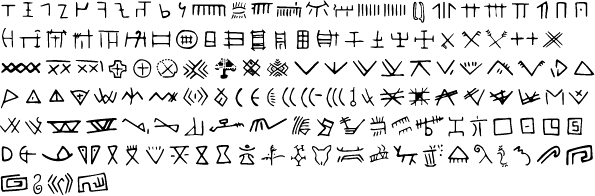
In all, for now a simple rendering with the current Latin alphabet suits our purposes. As for the future, no drastic projects are planned yet to construct or reconstruct a script for the reconstructed P.I.E. language, although these thoughts should be kept in mind...
Tuesday, August 9, 2011
Mission Statement
"Language and thought are inseparable. One is the expression of the other in physically communicable and recordable format - the degeneration of one leads to the degeneration of the other, and indeed for those modern forms of life there is no philosophical consequence to language - only the utterances of a confused and materialistic society who has lost all connection with primordial knowledge due not only to other factors, but the de-philosiphization of language itself. Words are not even seen as having innate meaning anymore - and thus, the languages of modernity lose all gnostic power for understanding truth beyond that of the physical realm, and thus true understanding altogether." - Etisoppo
Language is one of the few manifest thought forms that expresses the existential identity of a race (that is, manifested as a genetic continuum). And, it is doubtless that over time language has changed alongside the changes in demographic composition across Europe and the rest of the world. The original race to which the Proto-Indo-European language belonged to has long since diluted into the other blood streams of other races, with visible effects. Since the Indo-European language was at one time made the lingua franca between all the nations of Europe, the long-term dilution of the language’s original bearers has waned, and thus the pure and original Aryan language has suffered corruption and alteration at the nuances and thought forms of the other races and thus what we have today is a million descendents of the primordial Aryan language, each diluted by the natures of the various mixed stocks. For example, Slavic tends to cluster consonants together and delete the central vowel, a feature seen in many modern European languages, which is of course a detraction from the original form of the word. As words and grammar come in this way to change, the more difficult it becomes for those trying to regain the wisdom and the ways of primordial thought to grasp the ancient concepts, because the language in which it was retained is not the one that is spoken today. Today’s language has evolved to deal with concepts of the purely material world; it is designed to deal with the concepts of modern life and in the process loses its innate ability to aid in the synchronization in understanding ancient wisdom. The ancients and their language formed a synchronic system that allowed access to the wells of gnosis; if either one of these were corrupted, then the natural ease at which the ancients conceived time and space grew thicker and more difficult. So too, in the modern world, have both the degeneration of blood and the subsequent degeneration of language estranged mankind from the potential of becoming one with true knowledge. Needless to say, the implementation of a regenerative and progenitive eugenics program, which over the course of generations would gradually regain the past genetic fortification of Indo-European stock, would gradually, and over the course of many upon many generations, begin to show signs in the linguistics field; the return of superior and heightened genes will mean the gradual shift of modern language to a higher form of expressing thoughts that resembles that of the past. These new men would begin to use language in a way that fits the necessities of their higher thought processing, thus regaining what would more or less be a revival of the ancient thought pattern, that is, the primordial Aryan language. Therefore, the revival of that ancient thought pattern would regain the ease of access to the wells of knowledge.
However, in the slow centuries it will take to regain this language naturally, and thus recreate the ease in which the human race becomes attuned to the gnosis of truth, this tuning will be too distant in the future. Having to wait for the gene-pool to improve to such a degree that a semblance of the ancient language-form would naturally reemerge is daunting; it would severely stretch the gap between the attainment of superior knowledge (and therefore technology and mastery over physical forms) and the state of man’ s survival today. As it is today, the holy genes of the superior man are in dangerous threat of being deleted; waiting is not an option.
One conclusion by now would be to impose a reconstructed version of the primordial language, formed by reverse engineering to make a close approximate, onto all the candidate-bearers of the race; this is impractical, so much more because the majority of the race’s members are not evolved enough to fully exploit the power this grants them. Where this theory does, however, come into practical application is the scientific or research division, specifically, the occult division.
It is not uncommon for higher forms of government to implement branches of their technological research to the use of psychic and paranormal mediums and rituals to cast nets into the invisible abyss of unknown and untapped, primordial, subconscious reservoirs of race-memory. Here is where a proximate reconstruction of ancient languages comes into use in the immediate future. Not only will the use of the original languages with which this wisdom was originally retained and recognized boost the probability of finding this knowledge, but it will make up for the current lack of superior genetic specimens which to use as mediums. If race and language both form the whole of ancient understanding, and the language portion of this can be used, then we are empowered by at least half of our previous power.
Thus, we must go off seeing how one would reconstruct the ancient European language. What we must recognize are the various alterations which the mixed populations of modern day have applied to the original language; by listing and understanding these rules, we need only to reverse them in order to recreate a past semblance of the original word. This includes an analysis of all cognate roots in Indo-European derived languages and tracing them back to their original source. That will be the purpose of this blog: to document various studies that contribute to this field.
Post Scriptum – One observation that is easily seen by anyone is the exclusive use of Latin and Greek in classical occult ceremony. While this may be due to historical factors, it is coincidentally beneficial because both Latin and Greek retain almost perfect and only slightly altered forms of their original mother-tongue; to delve into the astral plains of the subconscious using Ancient Greek as the language-interface is in itself a potent possibility. It’s natural that the more debased the version of the language one uses, for example, modern Greek of Vulgar Latin, the less magical potency it will have.
Another issue is the refutation of the Marxistic axiom that language is completely relative; while historically and genetically this is true for the modern races, the languages of the ancient races were all aggluentively constructed using words that corresponded concretely and inalienably with certain ideas; we see that the constructions of Greek, Latin and even modern German words are not the mere nuances of inherited words from another language, as French or English has; ever compound is constructed with the specific combination of two ideas each represented by words. That is how the classical, or primordial, forms of language can be distinguished from the modern:
Modern – Often without cause or sense, a word means something “just because”, often because the word and its meaning is inherited from a former, older language. The speakers of these languages require no thought to process language; compound words are not recognized as compounds of separate and combined ideas but as separate words themselves. They do not recognize the construction of the compounded word and the sense it entails, nor the philosophical implications of the roots’ combination together.
Ancient – All words have sense; similar concepts are derived from each other, in perfect philosophical synchrony with their own thought forms; the purest expression of Aryan thought. When compound words are used, they are literally compounding the roots each time purposefully; this means that even if compound words were nonexistent in their language, they would continually create them again and again through the simple and natural use of their language. Phonemes are existential expressions of eternal ideas, etc. Also, they require absolutely no borrowing from other languages; everything can be expressed with their vocabulary of basic existential roots.
In this way, we hope to make the reconstruction of a usable Proto-Indo-European language one of the chief objectives of those interested in reviving gnosis and achieving man's salvation. It may end up being a very important factor in the current metaphysical war, for the lost wisdom of the past harbors the seeds of technologies that will surpass anything modern man has ever dreamt of, and lend our fighting forces - our soldiery - the weapons needed to win.
Sincerely,
.::RS::.
Subscribe to:
Posts (Atom)